About
Our Hounds
Introduction
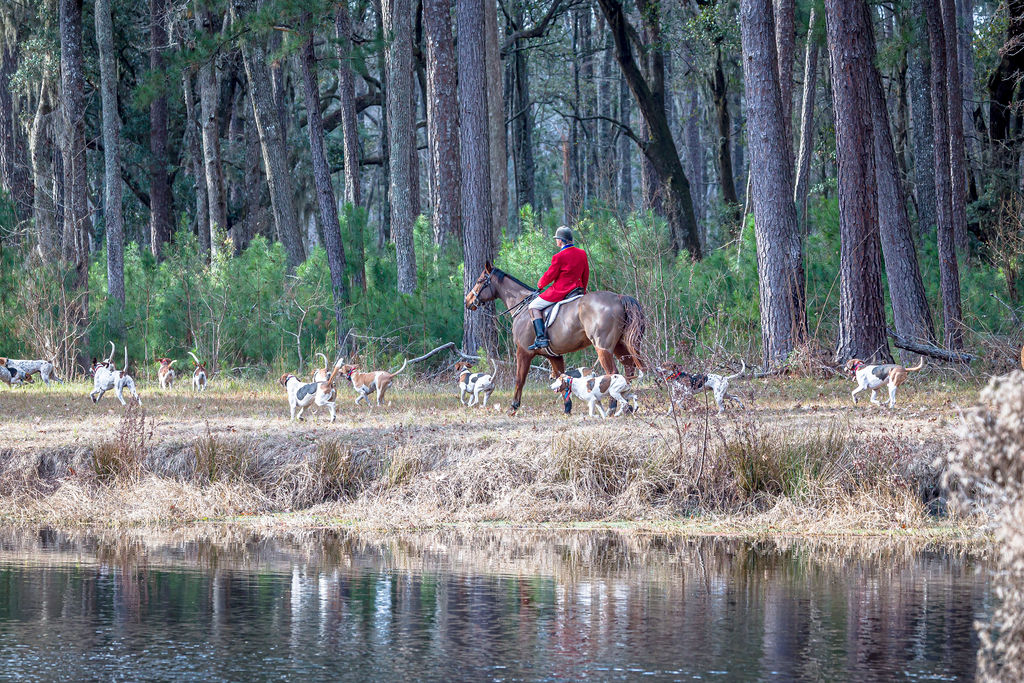
A riot of hounds pours out of the trailer at the meet. White, black, brown, and speckled, a mass of movement and slightly chaotic. A note on a horn, a well-placed word from a whipper-in, and this boisterous group falls into rank, and moves off into the hunting day. This is a pack of foxhounds, American Foxhounds.
Meet the Pack
Hound walks and kennel visits are arranged through the Hunt. Write to us and we will let you know what is planned this season.
The American Foxhound
In 1650, Robert Brooke landed in St. Mary’s County (originally Calvert County), Maryland with his family, servants, and his pack of foxhounds. In Virginia, the earliest note of hound in Virginia is in 1691 in Northampton County, Virginia. Other hounds were imported to the colonies, particularly to Virginia, Maryland, and Pennsylvania, from England, Ireland, and France. In 1830, Bolton Jackson imported Mountain and Muse from Ireland, and gave them to Governor Ogle of Maryland, and by breeding became part of the Trigg, Birdsong, Maupin, and Walker strains, as well as what were known as Virginia, Maryland, or Pennsylvania Hounds.
The American Foxhound is noted for its nose, cry, drive, stamina, and determination. Also it has the mentality to adapt to pack hunting, which is termed as biddability. Its adaptability has allowed it to hunt a variety of terrain from heavy woodland, mountains, sandhills, and swampland.
What’s in a Name?
The American Foxhound has been developed over three hundred years. It was recognized by the American Kennel Club in 1886. In 1916, the Masters of Foxhounds Association established a studbook for the American Foxhound. A hound has a three-part name that comprises where it was entered, its litter name, and the year it is entered. An example is Lowcountry Kestrel 2023. Kestrel was entered at Lowcountry, which is where she started hunting. Where a hound is entered does not necessarily indicate where they were bred, and the year is not the year it was born, but the year it starts hunting and the year it is entered in the studbook. Generally, the litter name is generated by the first letter in the dam’s name.
A Hound’s Life
A foxhound is a warrior. His life is packed full of desperate adventure, high speed, the tumult of camp, the roar of battle…
So we call them puppies. They are whelped generally a year to eighteen months before they are entered. Their life in the kennels before they are entered centers around learning their names, the routine of the kennels, and working into the pack. With any puppy, much is imparted by the kennel staff, but the largest part of their education comes from the older hounds. Early in their first season they are expected to follow the lead of the pack, and until they are steady, individual effort is generally discouraged.
The second season for the hound is where they are truly tested to their ability to become a long-standing member of the pack. From there, an American Foxhound is at its peak at around five seasons, but it is not uncommon for them to hunt well for a decade.
“A hound is true to his lord and master, and of good love and true. A hound is of great understanding and great goodness, a hound is a wise beast and a kind one. A hound has a great memory and great smelling, a hound has great diligence and great might, a hound is of great worthiness and of great subtlety, a hound is of great lightness and of great perseverance…”
Sources
- Hounds and Hunting Through the Ages, Joseph B. Thomas, MFH, 1937
- The American Foxhound, Haiden Trigg
- The Complete Dog Book, The American Kennel Club, 1979
- Gone Away, Mason Houghland, 1933
- A Foxhunting Anthology, Peter Lewis, 1935